Journal · 2026-08-11 · Dallas, TX
Cupping marks are not bruises — here is what those circles actually are

The circles are the first thing anyone asks about. They look like something went wrong. They did not.
A bruise and a cupping mark are opposites
A bruise is impact. Something pressed in hard enough to burst small vessels, and the tissue around them is compressed and inflamed. That is why bruises are tender.
A cupping mark is suction. The cup lifts skin and the layer beneath it away from the muscle, decompressing the tissue. Under that negative pressure, stagnant blood and fluid in the capillary bed are drawn up toward the surface, where they sit until the body reabsorbs them.
That is the whole mechanism. Nothing was crushed. The marks are usually not tender at all — press one and most people feel nothing.
What the colour tells you
Light pink or barely visible means the tissue underneath was already moving well. Nothing to draw up.
Deeper red and purple appear where circulation has been poor and the tissue is congested — typically the areas the client already complains about.
The useful part is that the marks fade faster each time you come. The same shoulder that produced dark circles in the first session often produces almost nothing by the fourth. It is one of the few things in bodywork where progress is visible from the outside.
Marks usually last three to seven days.
Why lifting reaches what pressing cannot
Most massage compresses. That works well on muscle, but fascia — the connective sheet wrapping the muscle — responds poorly to being pushed harder. Pressing tissue that is already stuck against itself just presses the stuck layers together.
Suction does the opposite: it separates the layers and lets fluid back into the space between them. That is why people who have plateaued with hands-only massage often notice a change after a session that includes cupping.
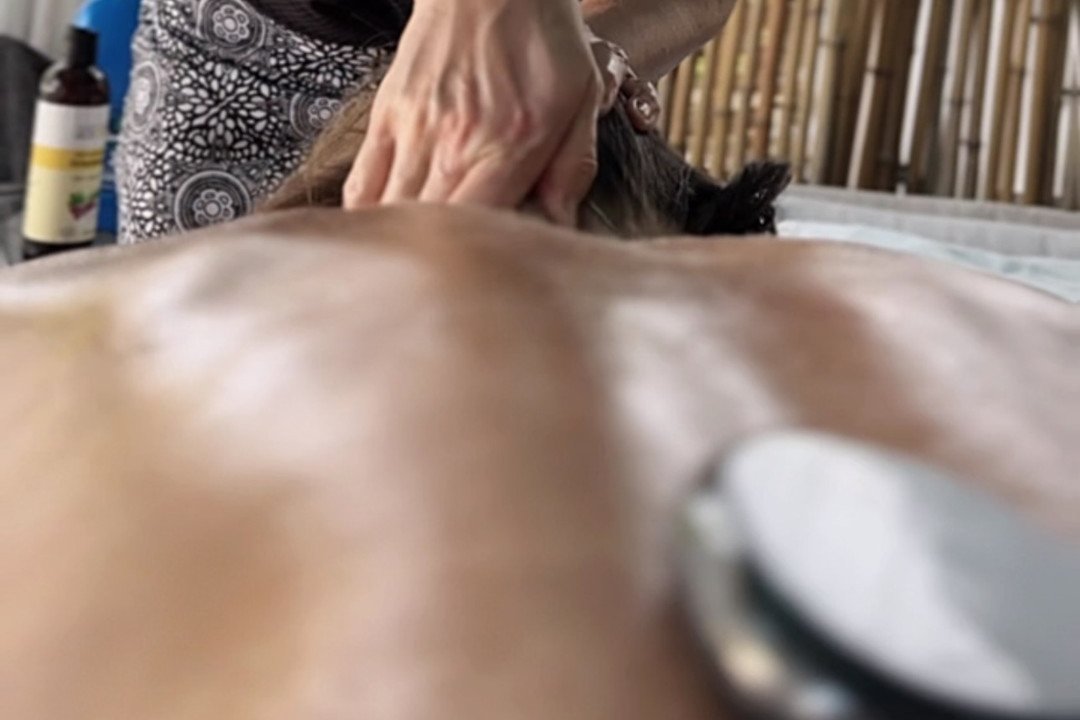
Cups can also be moved slowly across oiled skin rather than left in place, which gives a gliding release along a whole band of tissue and leaves much lighter marks.
Who should skip it
Cupping is not for everyone. Skip it, or ask your doctor first, if you take blood thinners, if you have a bleeding disorder, if the skin in the area is broken, inflamed or sunburned, if you have deep vein thrombosis or a history of it, or if you are pregnant and the area is the abdomen or lower back.
And a practical note: if you have a wedding, a beach holiday or a photo shoot within the week, book the cupping session for afterwards.
What it feels like
A strong pulling sensation, and then — for most people — nothing much for the next ten minutes. It should never feel sharp or burning. If it does, the suction is too strong and it comes off.
Read next
Massage before training or after: what the timing actually changes
Both are useful, but they are not the same session. What a short session before an effort does, what a session after does, and why race week is the wrong week to try either for the first time.

Foam rollers, massage guns and wooden tools: what they do and what they do not
Most of them work, within a narrow range, and most people use them for exactly the things they are worst at. An honest guide to what to keep in the cupboard.

Your first massage: the questions people are too embarrassed to ask
What you take off, what happens if you fall asleep, whether you have to talk, and the rest of what nobody explains because everyone assumes you already know.